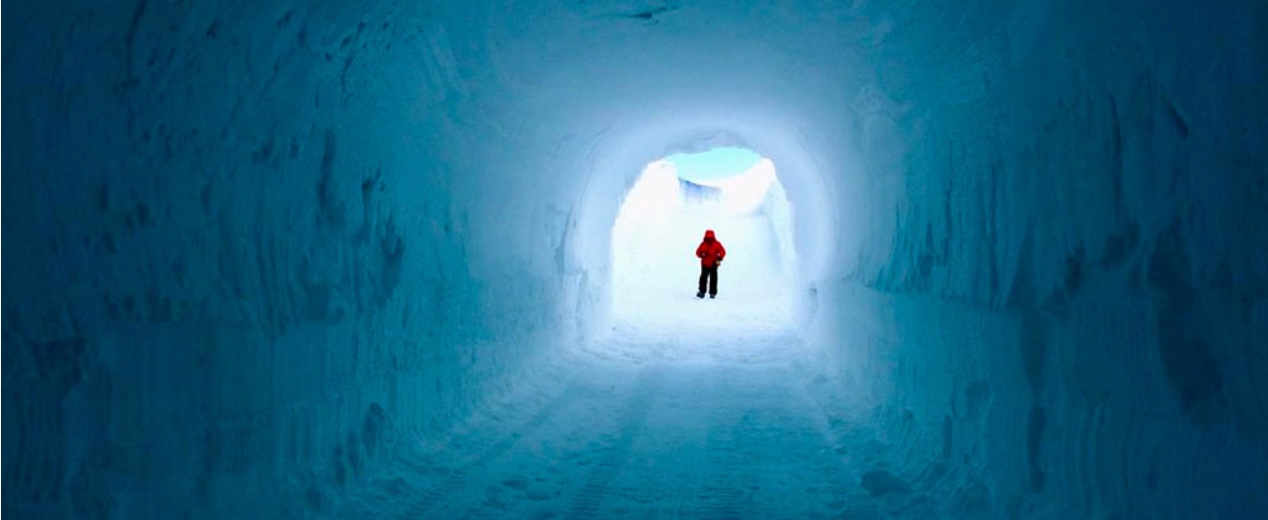
Cave balloon - Concordia Station
- Antarctica © Rocco Ascione / PNRA - ENEAIn the heart of Antarctica, a unique sanctuary will safeguard glaciers ice cores for centuries. Stored naturally at -50°C, these frozen archives from endangered glaciers will preserve our planet’s climate memory for generations to come.
The inauguration of the Sanctuary is scheduled on the 14th January.
Save the date 14/01/2026 10:00 AM CET.
For media: a live event will be organised from the Concordia Station in Antarctica.
To preserve heritage ice cores for centuries, Ice Memory built a unique sanctuary at Concordia Station, Antarctica.
Naturally maintained at -52°C, this low-impact snow cave offers secure, zero-energy storage conditions.

We have a historic responsibility today to engage with Ice Memory to build up a heritage of glacial archives for our children.
S.A.S Prince Albert II of Monaco, Honorary President of the Ice Memory Foundation.
Why Antarctica?
 Concordia station - Antarctica © Thibaut VERGOZ / IPEV
Antarctica offers the most stable natural conditions on Earth to preserve ice cores for centuries. Beneath the surface, temperatures remain naturally constant between -50°C and -54°C, year-round, without the need for energy-consuming refrigeration.
This environment eliminates risks linked to power outages, equipment failures, or geopolitical instability — making it the safest location for long-term ice core storage.
At 3,233 metres altitude, the French-Italian Concordia Station, operated by IPEV (Institut Paul-Émile Victor) and PNRA/ENEA, provides a robust scientific infrastructure in one of the coldest, driest and most remote regions of the world.
As part of the Antarctic Treaty System, this land is not claimed by any nation and is governed by international cooperation. Storing the ice cores here ensures their neutral status, protected from political interference and accessible only through scientific criteria.
How will it be built?
A natural snow-dug structure
-
35 metres long, 5 metres high and wide
- Dug 9 metres below the surface into compact snow
- No foundations, no artificial cooling
- 100% passive conservation using natural Antarctic cold (-52°C)
An innovative, low-impact design
- Designed by ENEA’s Antarctic Technical Unit, with support from IPEV
- Field-tested since the 2018–2019 summer campaigns
- Reinforced with natural snow arches for structural durability
- Compliant with the Madrid Protocol on environmental protection in Antarctica
A sustainable and approved scientific facility
- Approved in 2024 by the Antarctic Treaty System (ATCM46)
- Among the most remote and eco-responsible conservation sanctuaries ever built
- Ready to welcome the first ice cores by 2026
Ethical & scientific governance
The Ice Memory Sanctuary is founded on the principle that climate archives is at the service of humanity. The heritage ice cores stored in Antarctica will not be owned by any single nation or institution.
Access to these samples will be granted solely on scientific merit, based on ethical, transparent criteria — not geopolitical or economical interests.
Over the coming decades, a dedicated international governance model will be established, ensuring
long-term, fair and global access. The goal: make these frozen archives available to future generations of researchers, under
neutral and collaborative oversight.
For these cores to serve science in a century's time, they must be managed as a global common.
Thomas Stocker, University of Bern, Chair of the Ice Memory Foundation
 Thomas F. Stocker, Chair of Ice Memory Foundation, University of Bern, Switzerland © Adrian Moser
Partners and collaborators
- Supported by the Prince Albert II of Monaco Foundation
- French Polar Institute (IPEV)
- PNRA & ENEA for logistics and storage
- Scientific contributions from the IGE (Grenoble) and the CNR