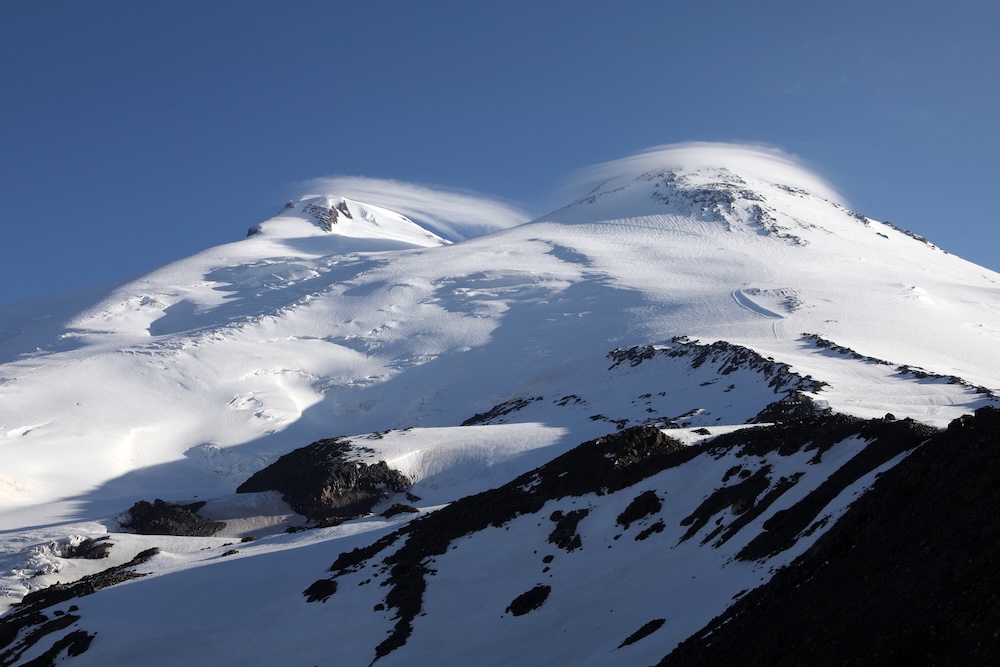
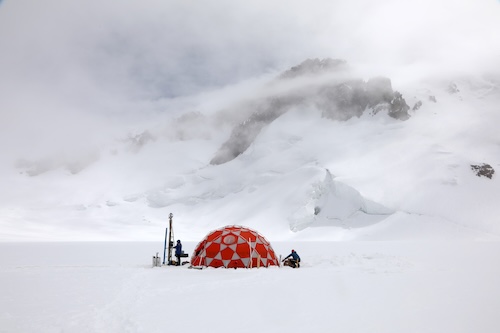
In June 2018, Ice Memory reached Mount Elbrus in the Caucasus, where high-altitude ice preserves more than 500 years of climate and environmental history. Despite challenging weather conditions, the team recovered two deep ice cores measuring 150 and 120 metres.
Objectives and key results
Number of ice cores drilled: 2 Drilling depth: 150 m and 120 m Climate record retrieved: More than 500 years
In June 2018, two deep ice cores were successfully extracted from Mount Elbrus, Europe’s largest ice-covered volcanic massif.
These cores preserve over five centuries of environmental and climatic history in the Caucasus region.
Why this site?
Mount Elbrus (5,642 m) is located in the Greater Caucasus, southern Russia. Covering approximately 115 km², its glacial system contains more than 10% of the total ice volume of the Greater Caucasus.
Several major rivers — the Baksan, Kuban and Malka — originate from the Elbrus glacier, sustaining agricultural lands and plains in the North Caucasus.
Elbrus was selected because:
Its high altitude (>5,000 m) ensures relatively well-preserved ice
It remains one of the few European glaciers where climate information is still largely intact
Previous drilling (2009) demonstrated its potential to provide unique data on environmental change, atmospheric pollution and volcanic activity
Continuous ice records from Elbrus can document approximately 500 years of regional climate history.
However, glacier shrinkage has accelerated in recent decades, increasing the urgency to preserve this archive.
The expedition
Period: June 2018 Duration: More than five weeks Conditions: Extremely difficult and unusual weather for the season
The expedition faced severe weather conditions that prevented drilling to the targeted depth of 250 m (bedrock).
Despite these constraints, the team successfully extracted two deep ice cores measuring 150 m and 120 m.
The team
The mission was coordinated by the Institute of Geography (Russian Academy of Sciences, Moscow).
The international team included:
Vladimir Mikhalenko, Institute of Geography, Moscow (Coordinator)
Stanislav Kutuzov, Institute of Geography, Moscow (Coordinator)
Ivan Lavrentiev, Institute of Geography, Moscow
Andrey Smirnov, Lomonosov Moscow State University
Pavel Toropov, Lomonosov Moscow State University
Nelly Elagina, Institute of Geography, Moscow
Anna Kozachek, Arctic and Antarctic Research Institute, St. Petersburg
Sarah Del Ben, Film Director (Wild-Touch, France)
Scientific analysis
Initial analyses are being carried out at the Institute of Geography of the Russian Academy of Sciences (Moscow).
The Elbrus ice cores provide essential data for understanding:
Share the linkCopyCopiedClose the modal windowShare the URL of this pageI recommend:Consultable at this address:La page sera alors accessible depuis votre menu "Mes favoris".Stop videoPlay videoMutePlay audioChat: A question? Chatbot Robo FabricaMatomo traffic statisticsX (formerly Twitter)