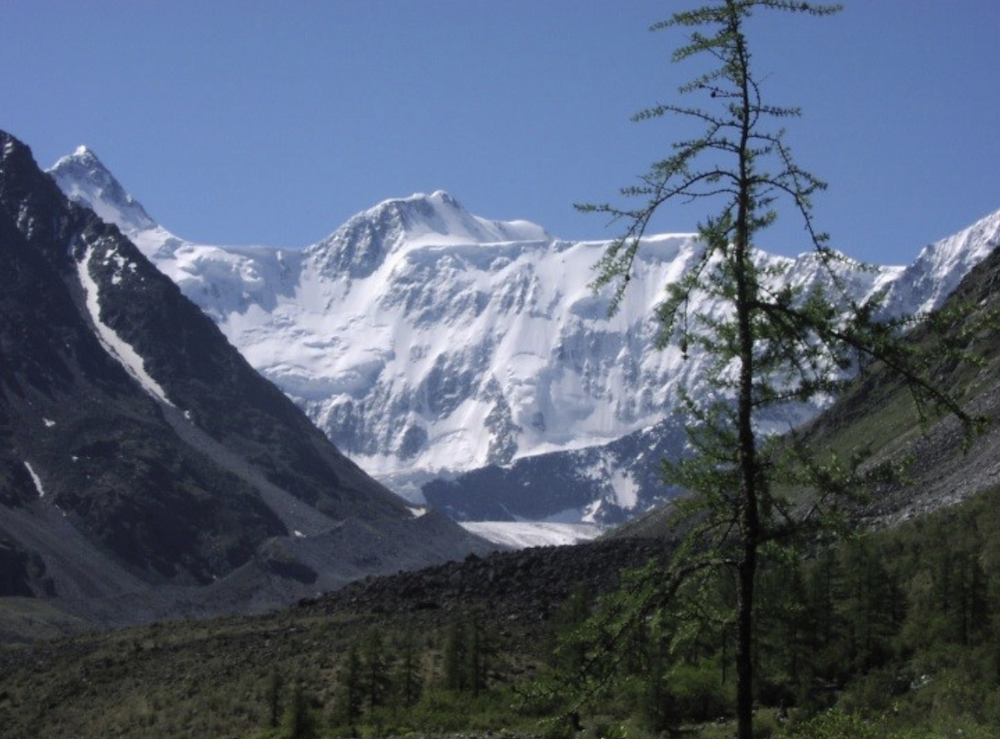
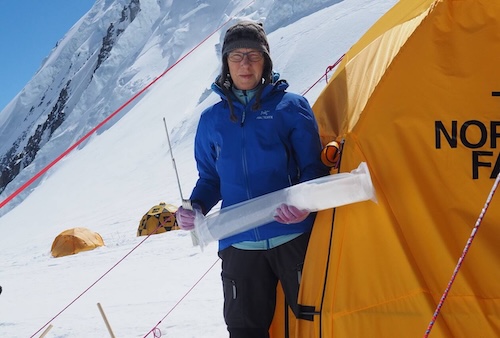
In May 2018, an international team drilled the Belukha Glacier in the remote Altai Mountains of Central Asia. Two ice cores were recovered, including a 160-metre core reaching bedrock, to preserve a climate archive already showing signs of increasing summer melt.
Objectives and key results
Number of ice cores drilled: 2 Drilling depth: 160 m (bedrock) and 106 m Climate record retrieved: Multi-century regional archive
In May 2018, two deep ice cores were successfully extracted from the Belukha Glacier in the Altai Mountains, a key paleoclimate site in north-western Central Asia.
1 core drilled to bedrock (160 m)
1 core (106 m) designated as the heritage core
Why this site?
The Belukha Glacier lies between the twin peaks of Mount Belukha (4,506 m), the highest summit of the Altai range. The Altai Mountains form a remote region at the crossroads of Kazakhstan, south-western Siberia, north-western China and Mongolia.
This region is of major paleoclimatic importance because:
It experiences a highly continental climate
It lies at the boundary between Siberian forests and the arid regions of Central Asia
It records atmospheric circulation patterns influencing both Eurasian and Central Asian climate systems
Previous drilling campaigns (2001 and 2003) confirmed Belukha as the most suitable site in the region for ice-core research.
Although ice temperatures remain below –14°C, freeze-back layers in the upper glacier indicate a sharp increase in summer temperatures — reinforcing the urgency to collect new cores.
The expedition
Period: May 2018
The drilling campaign was conducted as a joint project between:
The 106 m core was designated as the heritage core. ⇒ lien vers la page Sanctuaire
The team
The international team included:
Margit Schwikowski, Coordinator, Paul Scherrer Institute
Theo Jenk, PSI
Reto Schild, PSI
Michael Sigl, PSI
Julika Stampfli, PSI
Martina Barandun, University of Fribourg
Sergei Kopytin, Rescue Service of the Altai Republic
Andrei Obukhov, Rescue Service of the Altai Republic
Base Camp Support:
Tatyana Papina, IWEP-RAS
Stella Eyrikh, IWEP-RAS
Scientific analysis and heritage
One ice core will undergo detailed laboratory analysis, including:
Stable isotopes
Major ions
Trace chemical elements
Soot and organic tracers
These analyses will contribute to the regional and global climate reference database.
The second core will join the Ice Memory Sanctuary for long-term preservation.
Share the linkCopyCopiedClose the modal windowShare the URL of this pageI recommend:Consultable at this address:La page sera alors accessible depuis votre menu "Mes favoris".Stop videoPlay videoMutePlay audioChat: A question? Chatbot Robo FabricaMatomo traffic statisticsX (formerly Twitter)