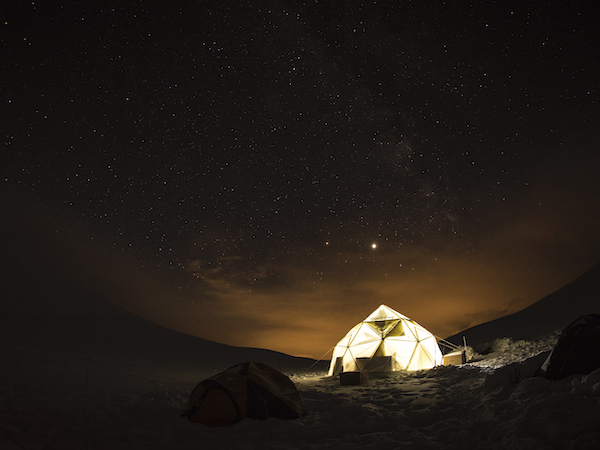
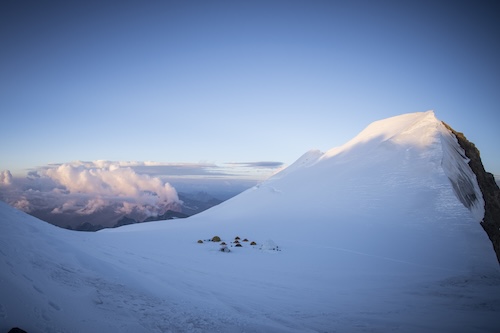
In September 2020, an international team drilled the Corbassière Glacier on Grand Combin in the Swiss Alps. Unexpected meltwater and ice layers prevented the team from reaching bedrock, revealing how rapidly warming conditions can affect the preservation of high-altitude ice archives.
Objectives and key results
Number of ice cores drilled: 3 Drilling depth: 26 m, 18 m and 16 m
In September 2020, an international team conducted a drilling campaign on the Corbassière Glacier, on Mount Grand Combin in the Pennine Alps.
Although the objective was to reach bedrock, only three shallow cores could be extracted due to altered glacial conditions.
Why this site?
The Corbassière Glacier extends along the northern side of Mount Grand Combin (4,314 m a.s.l.), between Mont Blanc and Monte Rosa, near the Swiss–Italian border.
Key characteristics:
Glacier area: 14.6 km²
Altitude range: 2,400 m to 4,314 m
Average altitude: 3,201 m
High plateau (~0.56 km²) at ~4,100 m
In 2018, a georadar survey conducted in collaboration with the Italian National Institute of Geophysics and Volcanology (INGV) identified a promising drilling site. Measurements indicated a maximum glacier thickness of approximately 100 m over a rocky saddle.
The site was selected for its potential to preserve high-altitude Alpine climate records.
The expedition
Period: September 2020 Conditions: Exceptionally high temperatures
Despite encouraging georadar data and the high elevation of the drilling site, the team encountered degraded glacial conditions.
Due to:
High frequency of ice lenses,
Presence of liquid water within the glacier profile,
Exceptionally warm temperatures,
it was not possible to drill down to bedrock.
Instead, three shallow cores were successfully extracted (26 m, 18 m and 16 m).
These conditions provided direct evidence of the impact of ongoing warming on high-altitude Alpine glaciers.
The team
The expedition was coordinated by Margit Schwikowski (Paul Scherrer Institute, PSI).
The international team included:
Theo Jenk, PSI
Thomas Singer, PSI
Jacopo Gabrieli, ISP-CNR / Ca’ Foscari University of Venice
Fabrizio De Blasi, ISP-CNR / Ca’ Foscari University of Venice
Rachele Lodi, ISP-CNR / Ca’ Foscari University of Venice
Paolo Conz, Mountain Guide
Riccardo Selvatico, Videomaker
Scientific analysis and heritage
Two of the ice cores were analyzed by PSI and ISP-CNR scientists to characterize the glacier’s present state and environmental signals.
The third core is intended to be transferred to Antarctica as part of the Ice Memory heritage initiative, contributing to the long-term preservation of Alpine climate archives.
Expedition partners and support
The expedition was funded by:
Italian Ministry of Education, University and Research (FISR special supplementary fund for research)
Paul Scherrer Institute (PSI)
Share the linkCopyCopiedClose the modal windowShare the URL of this pageI recommend:Consultable at this address:La page sera alors accessible depuis votre menu "Mes favoris".Stop videoPlay videoMutePlay audioChat: A question? Chatbot Robo FabricaMatomo traffic statisticsX (formerly Twitter)