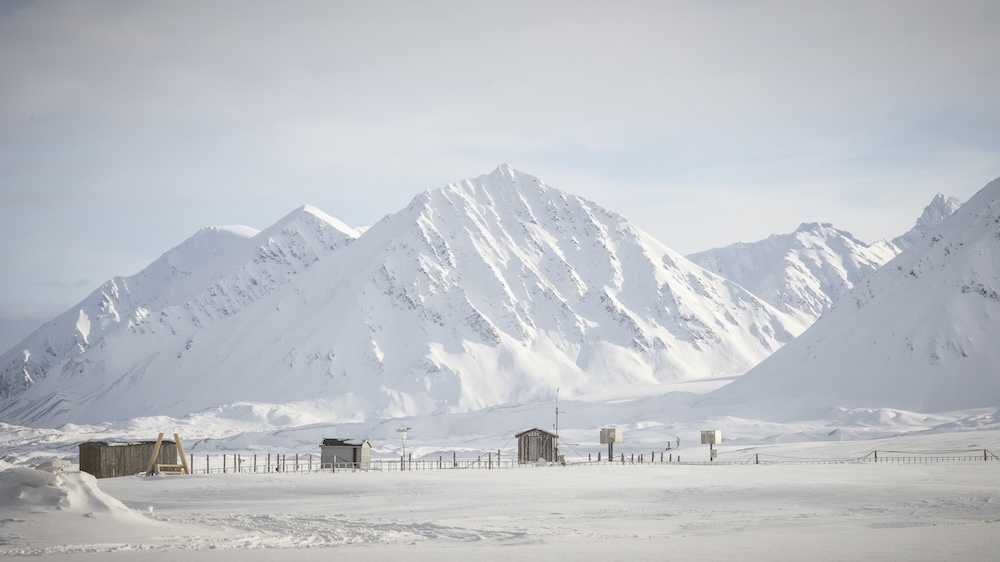
In April 2023, an international team recovered three 74-metre ice cores from Holtedahlfonna in Svalbard, preserving 300–400 years of Arctic climate history. Despite extreme weather and unexpected meltwater encountered inside the glacier, the team succeeded in securing this record of a rapidly changing Arctic.
Objectives and key results
Number of ice cores drilled: 3 Maximum drilling depth: 74 m Climate record retrieved: Approximately 300–400 years
In April 2023, the Ice Memory team successfully drilled three deep ice cores on Holtedahlfonna, one of the largest and highest icefields in the Svalbard Archipelago.
These cores preserve a unique Arctic climate archive at a time when the region is warming faster than most areas on Earth.
Why this site?
Holtedahlfonna is located in the High Arctic, at latitude 79.15° North. It is recognized as one of the most valuable Arctic sites for paleoclimatic research.
This glacier was selected because:
It provides significant regional information on climate variability in the high North Atlantic
It allows investigation of past variations in sea-ice extent
It preserves a high-quality Arctic environmental record spanning three to four centuries
It remains one of the few sites still capable of delivering well-preserved ice suitable for detailed paleoclimate studies
Holtedahlfonna represents a frozen library of Arctic history — documenting environmental and climatic shifts in one of the fastest-changing regions on the planet.
The expedition
Period: April 2023 Duration: 23 days Altitude: 1,150 m Location: 80 km from Ny-Ålesund research station
The remote camp was established 80 kilometres from Ny-Ålesund, in one of the northernmost inhabited research areas of the Arctic.
On April 4, 2023, the team reached the drilling site. After several days of extreme weather — with perceived temperatures down to –40°C due to wind chill — drilling operations began on April 8.
While drilling at 24.5 meters depth, liquid water appeared in the borehole.
As Daniele Zannoni (Ca’ Foscari University of Venice) stated: “Seeing all that water into the glacier gave us the clearest evidence yet of the effects that dramatic climate change is having in the Arctic.” Despite high water content in the upper layers and severe weather conditions, the team successfully drilled three deep ice cores.
The team
The international team included:
Andrea Spolaor, Expedition leader, ISP-CNR (Italy)
Jacopo Gabrieli, ISP-CNR (Italy)
Catherine Larose, CNRS (France)
David Cappelletti, University of Perugia (Italy)
Victor Zagorodnov, Cryosphere Research Solutions LLC (USA)
Fabrizio De Blasi, ISP-CNR (Italy)
Daniele Zannoni, Ca’ Foscari University of Venice (Italy)
Jean-Charles Gallet, Norwegian Polar Institute (Norway)
The three collected cores represent a significant scientific and cultural heritage in the context of rapid Arctic warming.
This successful operation ensures both:
The detailed scientific analysis of the Arctic climate archive
The long-term preservation of its environmental record within the Ice Memory framework
Holtedahlfonna contributes critical knowledge about Arctic climate dynamics, sea-ice variability, and environmental change over the past three centuries.
Share the linkCopyCopiedClose the modal windowShare the URL of this pageI recommend:Consultable at this address:La page sera alors accessible depuis votre menu "Mes favoris".Stop videoPlay videoMutePlay audioChat: A question? Chatbot Robo FabricaMatomo traffic statisticsX (formerly Twitter)